
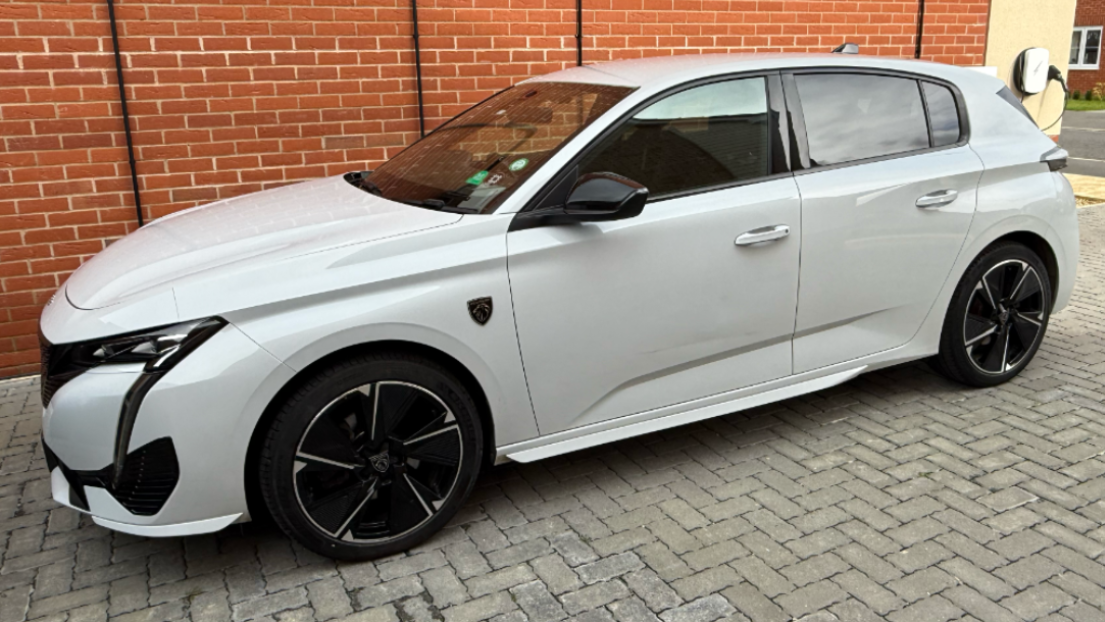
I had been driving our Peugeot e-308 GT for around ten months and 10,000 miles when I first wrote this review. That is long enough for the novelty to wear off and the compromises to become clear.
It is a 73-plate car rather than the newest version, but it remains the e-308 we use every day and regularly drive between Suffolk and Normandy.
July 2026 update: the ownership verdict and real-world range figures below still reflect our experience. We have since moved our home charging from Intelligent Octopus Go to EDF Go Electric with EDF Smart Charging. The current cost example has been updated using our 6.99p overnight rate.
The verdict at a glance
| What is good | What is less good |
|---|---|
| Comfortable and quiet on long journeys | Real motorway range is well below the headline figure |
| Distinctive Peugeot driving position | Wireless CarPlay can be unreliable |
| Low home-charging costs | No wireless phone charging in our car |
| Good-quality, practical interior | GT tyres are vulnerable on poor rural roads |
| Capable enough for regular UK–France travel | Longer journeys require frequent charging stops |
Peugeot e-308 reliability: the short answer
After 10,000 miles, our Peugeot e-308 had given us no major mechanical concerns. It remained comfortable, quiet and dependable for everyday use and repeated long journeys to France.
The main frustrations were not breakdowns. They were the gap between headline and motorway range, occasional wireless CarPlay problems, connected-software quirks and the cost of replacing tyres damaged by potholes.
Why the e-308?
I am not new to Peugeot. Previous cars have included a 205, 306, 407, 208 and e-208, so the e-308 was a natural step when we wanted a larger electric car.
We also have a Peugeot e-208, making ours a two-EV household. Both cars charge at home through a Hypervolt Pro 3, supported by solar panels and a Tesla Powerwall. Our six-month solar and Powerwall results show how EV charging fits into the wider energy system.
The e-308 is larger and more comfortable than the e-208 without feeling cumbersome. It also retains the distinctive Peugeot interior and small steering wheel that I already liked.
Peugeot e-308 real-world range
The number people ask about first is range.
The dashboard can show roughly 250 miles after a full charge. In the mixed driving we actually do, including dual carriageways, motorways, heating, hills and faster French roads, I normally plan around approximately 140 miles.
That is a substantial gap from the official-style headline figure, but it is the number that has proved useful for our journeys.
Around town and in milder conditions the car can do better. Sustained motorway speeds, cold weather and cabin heating reduce it. I would rather plan conservatively and arrive with charge remaining than build a journey around the most optimistic number the dashboard has displayed.
For daily use, 140 miles is more than enough. Charging happens at home every few days and rarely requires any thought.
What home charging costs us
A typical charge from roughly 20% to 100% uses around 40kWh from the charger.
On our current EDF overnight rate of 6.99p per kWh, that electricity costs about £2.80.
Using our normal 140-mile planning range, that is approximately 2p per mile for the electricity entering the car.
This is not a universal e-308 running cost. Charging losses, temperature, driving style and tariff all affect the result. Public rapid charging is also considerably more expensive than charging at home.
The car is now charged through EDF Smart Charging and our Hypervolt. Our reasons for replacing the previous charger are covered in Pod Point vs Hypervolt Pro 3.
Driving to Normandy
We regularly drive roughly 350 miles to our second home in Normandy.
The journey normally requires three or four charging stops, depending on weather, traffic, speed and where we begin the trip. France’s 130km/h motorway limit and sections of hilly terrain make a noticeable difference to consumption.
The car can rapid-charge at up to roughly 100kW. In good conditions, a useful 20% to 80% stop takes around 25 minutes. That is enough time for a short break without making every stop feel excessive.
French motorway charging coverage has improved considerably during our ownership. We have used service-area networks and Tesla Superchargers that are open to non-Tesla cars. Away from the motorway, charging can be slower or less conveniently located, so we plan more carefully around our destination.
One practical lesson is to avoid busy motorway services around the French lunchtime peak where possible. Chargers, restaurants and parking can all become congested at the same time.
How it drives
Peugeot’s small steering wheel and raised instrument display give the e-308 a particular feel.
I like it. Some drivers do not, and a test drive is essential because the driving position can divide opinion within minutes.
The GT rides well and remains comfortable over long distances without feeling soft or detached. The electric drivetrain is smooth and quiet, with enough immediate power for overtaking and maintaining speed on French motorway climbs.
It is not a performance car, but it never feels underpowered for the way we use it.
Interior and technology
The cabin balances physical controls and screens better than many newer cars.
The central display works well for maps and everyday settings, while the digital instrument panel can be configured to show the information I care about. The interior feels modern without attempting to place every function behind one enormous touchscreen.
Wireless Apple CarPlay is my main interface for navigation and music. It works well most of the time, but it can occasionally disconnect or fail to connect on the first attempt.
Our car also lacks wireless phone charging. That feels odd when wireless CarPlay encourages the phone to stay out of sight while still consuming battery.
The seats remain comfortable on long journeys. Rear space is acceptable rather than generous, and the centre pass-through has proved useful for longer items. The boot is a practical size for a hatchback, including trips with our dog and luggage.
The biggest frustration: tyres
Our GT has lower-profile tyres on 18-inch wheels. They look good, but they have not coped well with the worst roads around the Suffolk and Cambridgeshire border.
During the first ten months, we replaced three tyres after pothole damage.
That is partly a reflection of local roads rather than an inherent mechanical fault with the car. It is still a genuine ownership cost. With hindsight, a trim using smaller wheels and a deeper tyre sidewall might have been the more practical choice for rural driving.
Anyone considering the GT should price replacement tyres and think honestly about the condition of the roads they use most often.
Peugeot e-308 reliability after 10,000 miles
Mechanically, the e-308 gave us no major concerns during the period covered by this review.
The frustrations were around:
- real-world motorway range
- occasional wireless CarPlay issues
- Peugeot’s connected software
- tyre damage caused by poor roads
The car itself remained comfortable, quiet and dependable.
That distinction matters when assessing reliability. The software annoyances and damaged tyres affected ownership, but neither amounted to a major fault with the electric drivetrain or the car’s core mechanical systems.
Would I recommend it?
Yes, with two conditions.
First, test the driving position. The small steering wheel and raised instruments are a defining part of the experience, and not everybody likes them.
Second, make sure the realistic range works for your journeys rather than relying on the largest number shown in advertising or on the dashboard.
For daily driving and home charging, the e-308 suits us extremely well. It can also handle regular trips to France, provided we accept the charging stops and plan around them.
After 10,000 miles, I had no regrets about choosing it. The range is imperfect and the tyres have been costly, but neither has outweighed the comfort, low home-charging cost and everyday ease of living with the car.