A smart home in a second property should provide peace of mind.
It should tell us what is happening when we are hundreds of miles away, alert us when something needs attention, and reduce the number of times we need to ask somebody locally to visit the house.
Our current setup in France is increasingly doing the opposite.
We have used Eve temperature and humidity sensors and Eve Energy smart plugs for several years. Some of the devices have been useful, they look great, and they offer features that we still genuinely like.
But in our particular house, and for the way we need to use them, they have not proved reliable enough.
We’ve reached the point where we’ve done all we can to make Eve work for us, including throwing money at it. But there comes a point where you have to realise that it simply isn’t working.
Why we chose Eve in the first place
Our use of Eve equipment goes back to when we lived in the Netherlands.
At the time, there were fewer good products that worked properly with Apple HomeKit. Eve had a strong reputation, the products had a clean and minimal design, and they fitted well into an Apple-based home.
We used Eve Energy smart plugs and Eve Degree temperature and humidity sensors.
When we started spending more time at our house in France, moving some of that equipment there seemed sensible.
The French internet package we originally had from Free included an Apple TV, which gave us an Apple Home hub without needing to buy another device. We later moved from Free to Starlink and have now returned to fibre through Sosh, but the Apple TV has remained at the centre of Apple Home in France.
Using equipment we already owned saved money, and it was familiar.
At the time, that felt like a practical decision.
How the Eve network is arranged
The house runs roughly from east to west.
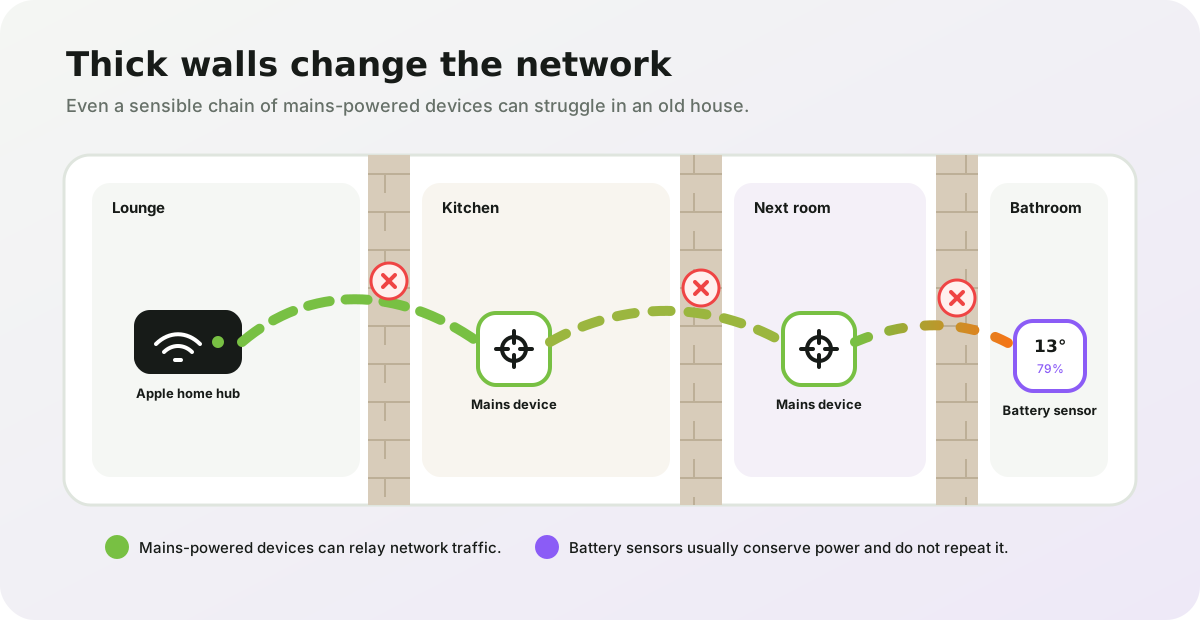
At the eastern end, the Apple TV is positioned in the corner of the lounge. In the same room, we have an Eve Energy connected to the wall extractor and an older Bluetooth-only Eve Degree.
A thick wall separates the lounge from the kitchen. In the kitchen, we placed another Eve Energy and an Eve Weather.
The next room has a further Eve Energy and Eve Weather. At the western end of the ground floor, the bathroom has another Eve Weather.
Upstairs, directly above the lounge, there is an additional Eve Weather.
This was not a case of placing one Apple TV at one end of the building and expecting every battery-powered sensor to reach it.
When we began experiencing connection problems, we deliberately added mains-powered Eve Energy plugs between the rooms. Some of those plugs were not controlling anything important. We bought them mainly to strengthen the Thread network.
That approach made technical sense. Eve says its mains-powered, Thread-enabled Eve Energy units can act as router nodes and relay data, while battery-powered Eve Weather devices are endpoints rather than repeaters. You can read Eve’s explanation on the Eve Energy product page.
Initially, adding the extra Eve Energy units seemed to help.
Unfortunately, the improvement did not last.
The battery problem
The Eve temperature and humidity sensors need their batteries replacing far more frequently than we would like.
We tend to change them on almost every trip to France, or every second trip. In practice, that means roughly every two to four months.
Some of those batteries may still have life left when we replace them. However, because we are leaving the property empty again, we want to be confident that they will continue working until our next visit.
That creates waste, cost and uncertainty.
By comparison, the Aqara temperature and humidity sensors we use in the UK generally last for well over a year. Some have reached around 18 months.
A battery change is a minor inconvenience in the house where you live.
It is a very different problem when the device is in another country.
The devices that are currently offline
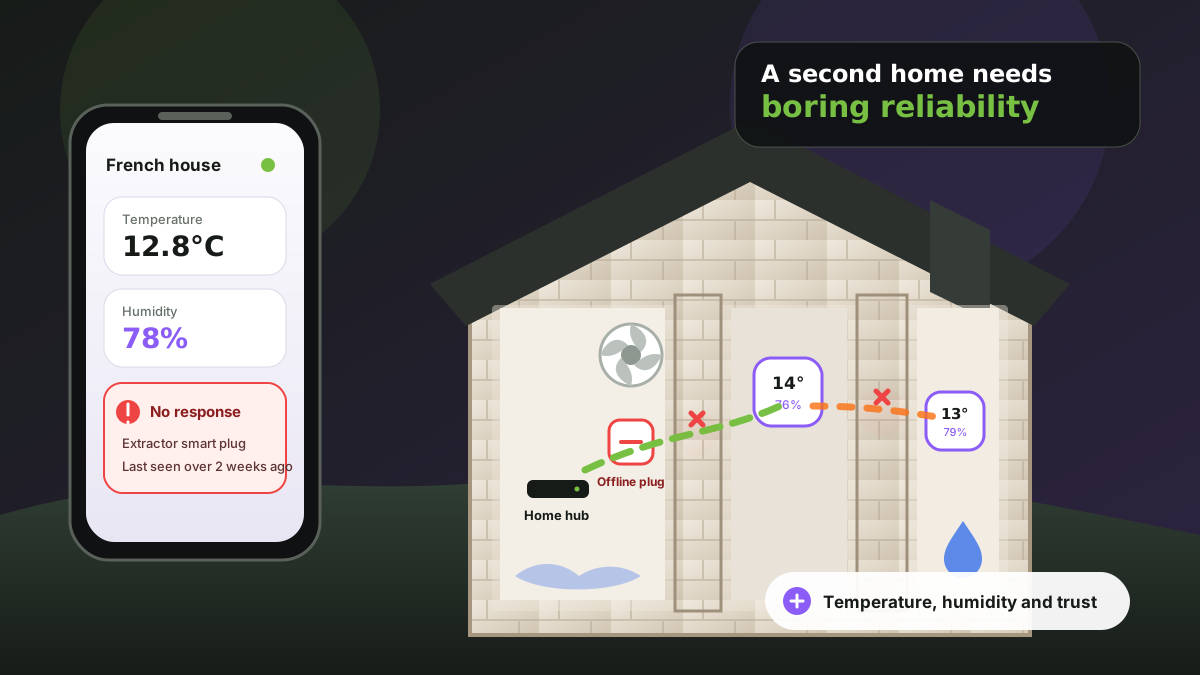
The Eve Energy controlling the extractor in the lounge is currently unavailable.
The older Bluetooth-only Eve Degree in the same room is also very intermittent and has now been offline for more than two weeks.
We cannot tell remotely whether the Degree has simply lost its connection or whether its battery has run out.
The lounge is also where the Apple TV is located, so these are not devices at the far end of the house behind multiple walls.
The Eve Energy is unavailable in both Apple Home and the Eve app. That is important because it suggests this is not simply Apple Home displaying the accessory incorrectly.
The extractor is probably still running continuously.
The local lad who checks the property for us said it was on during his last visit. But with the Eve Energy offline, we cannot confirm its current state, see whether it is drawing power or change it remotely.
We think it is running.
We do not actually know.
That uncertainty is the real problem.
Why temperature and humidity monitoring matters
This is not simply about wanting another graph in an app.
The French house currently has a significant humidity problem.
We have previously found pools of water on the living-room floor tiles. The floor is consistently cold and may be contributing to the problem.
We have also experienced some minor mould issues upstairs.
A new roof is due to be installed in the next couple of months, and we hope that will improve at least some of the upstairs problems. However, we are not assuming that the roof work alone will solve the wider humidity issue.
When the house is empty, we need to know:
- what the temperature is;
- how high the humidity has become;
- whether the extractor is operating;
- whether a device has gone offline;
- and whether the property still has electricity and internet access.
Without reliable readings, we cannot tell the difference between a failed sensor and a genuine problem inside the house.
The wall extractor
The lounge has a Bosch wall extractor with its own humidity sensor.
We originally connected it through an Eve Energy and scheduled it to run for one hour in every four. That gave us six hours of extraction during each 24-hour period.
One feature we have valued is the ability of Eve Energy schedules to continue independently of a phone or internet connection. Eve describes this feature on the Eve Energy page.
That is particularly useful in a remote house.
However, the original schedule did not appear to reduce the humidity sufficiently.
While trying to adjust it, we noticed that communication with the Eve Energy was becoming intermittent.
Around the same time, a severe thunderstorm caused the main electricity supply to trip. Initially, we thought the fibre connection or fibre equipment had failed.
The local lad visited and found that the electricity had tripped at the main fuse box.
Once power was restored, we changed the extractor to run throughout the day, and later to run day and night.
We believe it is still doing that, but we cannot confirm it remotely.
What we want the extractor to do in future
The wall extractor can continue responding to its own built-in humidity sensor.
However, we also want the socket or controller to respond to humidity readings from sensors elsewhere in the house.
That would allow the extractor to operate when humidity rises in another room, rather than relying only on the conditions immediately beside it.
We may also install a second Bosch wall extractor.
The ideal system would give us:
- reliable temperature and humidity readings throughout the property;
- automatic extractor control;
- clear confirmation that the extractor is drawing power;
- alerts when humidity rises too far;
- and the ability to change settings remotely.
Power monitoring would not prove that a fan or dehumidifier was working perfectly, but it would show that it was switched on and consuming electricity.
That would still be much better than the uncertainty we have now.
A remotely controlled dehumidifier may also form part of the solution
We are also considering a dehumidifier with app control and a continuous drainage hose.
A normal dehumidifier tank would eventually fill while the property was empty. A drainage hose would allow it to run for longer without somebody needing to visit and empty it.
The dehumidifier would probably use its own built-in humidity sensor and controls.
We would like to be able to monitor it through its own app, adjust its target humidity remotely and receive alerts when something needs attention.
Ideally, it would start and stop automatically as humidity changes.
It would not replace the need to understand and address any building-related issues, but it could provide another layer of protection against damp and mould when we are not there.
Why our view of Eve has changed
We are not saying that Eve products are rubbish.
They look good, have useful features and worked well enough for us for a period of time.
Our setup also includes different generations of equipment.
The original Eve Degree is Bluetooth-only. The later Eve Weather units and Eve Energy plugs use Thread, but even those devices are now at least two or three years old.
Newer Eve hardware may behave differently.
We have not tested it, so we cannot fairly judge it.
We can only judge the products we own, in the house where we use them, for the job we need them to perform.
For us, the price is becoming difficult to justify against the real-world reliability we have experienced.
When equipment is needed to protect and monitor an empty property, attractive design and clever features are not enough.
Reliability and ease of use come first.
Our experience with Aqara
We have used Aqara equipment for around two years.
The first Aqara sensor was bought while we were still living in the Netherlands, after some of the Eve equipment had been moved to France.
Aqara is not necessarily cheap, but it is generally cheaper than some of the alternatives we have considered.
More importantly, we have first-hand experience of it.
Our current UK setup includes:
- an Aqara Climate Sensor W100;
- an Aqara Presence Sensor FP300, which also reports temperature and humidity;
- three additional temperature and humidity sensors;
- and an Aqara air-quality sensor.
The exact model of the air-quality sensor escapes me at the moment.
Battery life has generally been excellent, with most sensors lasting well over a year and some around 18 months.
The Aqara setup was less reliable when we only had a small number of devices.
As we expanded it and adjusted positioning, it became much more dependable.
We now know that simply adding more battery-powered sensors does not necessarily strengthen a Zigbee mesh. To plan the French network properly, we need to think about the position of the hub and identify suitable mains-powered devices that can help provide stable coverage through the house.
Apple Home will remain at the centre
We do not currently plan to install Home Assistant in France.
At least in the short to medium term, we want Apple Home to remain the main interface for sensors, automations and remote control.
The Apple TV will continue as the Apple Home hub. Apple explains that Apple TV can provide remote accessory control and automations, while Thread support depends on the specific model. The current requirements are covered in Apple’s home hub guidance.
Individual products may still use their own apps where they provide more detailed controls.
For example, a dehumidifier may need its manufacturer’s app for target humidity, drainage alerts or operating modes.
But we want Apple Home to provide the central view wherever possible.
The French system should be simpler than our UK Home Assistant setup.
It needs to work reliably without becoming another platform that constantly needs maintaining.
Aqara is currently the likely solution
Based on our current research and experience, we are fairly sure Aqara will form the environmental monitoring and automation part of the new setup.
The likely plan is to move our existing Aqara M2 hub from the UK to France, along with some of the sensors we already own.
However, that creates another decision.
Once the M2 moves, we will need to replace it in the UK.
We are therefore taking the next few weeks to investigate the UK replacement and design both systems together.
We may use a mixture of existing and new equipment in France, rather than buying everything again from scratch.
The difference this time is that we will plan the network before buying the devices.
The cameras are part of the wider decision
The cameras in France are currently working reasonably well.
We have two Eufy indoor pan-and-tilt cameras. They connect directly over Wi-Fi and can be viewed through Apple Home.
We also have two EufyCam 2C Pro cameras connected through a HomeBase 2.
The HomeBase currently connects over Wi-Fi because there is no Ethernet connection nearby. Its location is partly dictated by the need to maintain a connection to both outdoor cameras.
This setup was less reliable when the property used the old Starlink connection and network arrangement.
Since installing a UniFi Dream Machine and an Ethernet-connected UniFi AC Mesh access point, Wi-Fi coverage has improved and the HomeBase connection has become more reliable.
The Eufy system does not need replacing immediately.
Battery life on the 2C Pro cameras is still reasonable.
When those batteries begin to degrade significantly, however, we are likely to move towards cameras with permanent power and wired networking.
UniFi is likely to become the backbone
We are already heavily invested in the UniFi ecosystem in the UK.
We are about 90% certain that UniFi will form the longer-term backbone for internet access, routing, cameras and Talk in both properties.
We already use UniFi Talk in the UK, with AAISP providing the phone service.
Installing a UDR7 in France could allow us to extend that setup there in future.
We may also add a UNAS in the UK, although that is another potential project and article in its own right.
For cameras, the likely long-term direction is UniFi Protect with PoE cameras.
We want external cameras in the UK soon, which gives us a useful opportunity to test UniFi Protect properly before making a similar investment in France.
That will help us decide whether to go all-in with Aqara, including cameras, or continue with a hybrid setup using Aqara for sensors and automation and UniFi for networking and surveillance.
At the moment, the hybrid approach feels more likely.
Alerts we actually need
The aim is not simply to collect more data.
We want useful alerts that tell us when action is needed.
The priorities are:
- humidity becoming too high;
- temperature becoming unusually low or high;
- sensors or important devices going offline;
- low batteries;
- loss of power or internet access;
- and changes in power usage that suggest equipment has stopped operating.
In future, we would also like to add door and window sensors.
These would provide another form of security monitoring while the house is empty, alongside the cameras.
We are not trying to build a professional alarm system.
We simply want clear notifications if a door or window opens unexpectedly.
What success would look like
Six months after the change, we would like to have:
- dependable temperature and humidity readings;
- automatic control of the extractor;
- remote management of a dehumidifier;
- fewer battery changes;
- mains-powered equipment helping to provide a stable network;
- useful remote alerts;
- power monitoring for important appliances;
- and fewer occasions when somebody needs to visit the house on our behalf.
At present, we sometimes have to pay the local lad to check the property.
That costs money, and as he gets older he is understandably becoming less available.
We cannot build the system around the assumption that somebody will always be able to travel over and reset a device.
The technology needs to reduce those visits, not create them.
Thinking before buying
Our original French setup grew from equipment we already owned.
We tried to make it fit because it saved money and because it was familiar.
That was understandable, but it also meant the system was never properly designed around the property or the job it needed to do.
This time, we are thinking ahead.
We need to decide what remains in the UK, what moves to France, where the hubs should be positioned, which devices should use batteries and where mains-powered equipment would be more appropriate.
We also need to consider humidity control, power monitoring, security sensors, cameras, networking and remote access as parts of the same wider environment.
We are pretty sure Aqara will be the solution for much of the sensing and automation, based on our current research and first-hand experience.
UniFi is likely to provide the longer-term network and camera infrastructure.
Eufy can remain in place until there is a genuine reason to replace it.
Over the next few weeks, we will map out the complete plan before buying anything.
Once the UK replacement equipment has been selected and installed, we can move the M2 to France and start rebuilding the French setup using a mixture of existing and new devices.
This time, we want to design the system around reliability from the start.
And once it has been running for long enough to judge properly, we will report back on whether it actually worked.